
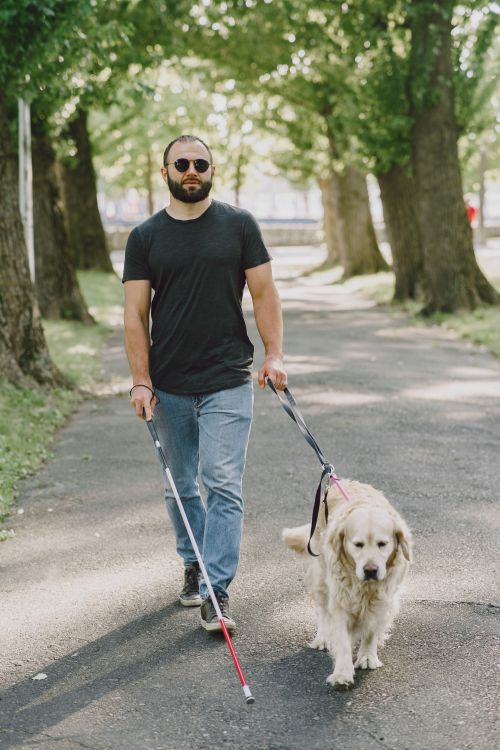
When “Paws for Thought” was published, I expected it to generate some discussion. I didn't expect to hear from former professional guide dog trainers.
Yet within days, several reached out: people who have spent careers at the sharp end of working animal training, people who understand what it takes to prepare a guide dog for the streets, the stations, and the crowds of daily life.
They brought to my attention that in relation to Guide Dogs, changes made by the charity have shifted training responsibility away from qualified professionals and onto guide dog owners themselves. In practical terms, this means that in some circumstances the person being assessed is also the person doing the assessing. They're, as one former trainer put it plainly, marking their own homework.
I'm not questioning the integrity of guide dog owners, but self-certification, in any safety-critical context, isn't a reliable standard and probably creates an unwelcome burden on the owner.
The problem with marking your own homework
Every profession that carries responsibility to the public understands this. Solicitors do not sign off their own practising certificates. Pilots do not certify their own fitness to fly. Surgeons do not conduct their own competency reviews. The independence of the assessor from the person being assessed isn't bureaucratic formality: it's the mechanism by which public trust is established and maintained.
Working assistance animals occupy a unique position. A guide dog isn't a pet that accompanies its owner. It's an instrument of independence for a disabled person navigating a world that's not designed with them in mind. The working relationship between dog and handler is complex, demanding, and consequential. When that relationship functions well, it's transformative. When it doesn't, the consequences can include injury, loss of mobility, and the withdrawal of independence.
The people who raised this issue with me have seen the system from the inside. Their concern is that by displacing the professional assessor and placing accountability on the owner, there is a risk that the public and service providers might lose confidence that working animals are trained to a consistent, independently verified standard.
What my last article recognised was that when a venue admits a working animal, it does so in reasonable reliance on the existence of a professional framework that ensures the animal is fit for that environment. When a business makes adjustments for an assistance animal user, it extends those adjustments in good faith based on the same assumption.
If the standard is eroding, or is no longer independently verified, that assumption becomes precarious for everyone.
Service providers face an increasingly difficult position. They must be careful about interrogating a working or support animal owner about their animal's training. They cannot demand documentation that does not consistently exist. Yet they remain liable if something goes wrong.
The disabled person, meanwhile, faces the prospect that their animal — and by extension their freedom to move through public life — may be viewed with growing scepticism by the very businesses and venues they are entitled to access. The absence of a credible standard does not protect anyone. It simply distributes the risk invisibly and inequitably, and undermines public confidence.
The case for national accreditation
The feedback wasn't all about the problem; it also pointed to a solution which is neither radical nor untested. Norway has had a working animals accreditation scheme for some years, administered by the Police. It functions, in essence, as a national competency test for working animals and their handlers — an independent, standardised, third-party assessment of whether the working relationship meets the required standard. A bit like the UK's cycling proficiency test: a recognised, publicly endorsed certification that confers confidence on the holder, creates clarity for third parties, and provides a benchmark that is objective and reproducible.
I'm not a fan of red tape or of bureaucracy for its own sake, but a similar national accreditation scheme seems like a logical and proportionate response to a gap that currently leaves disabled people, service providers, and the working animal sector in an uncomfortable state of shared uncertainty.
A national scheme would not prevent anyone from having a working animal. It would establish, clearly and transparently, what having a working animal means — and what standard the public, the law, and the market are entitled to expect.
The benefits are wide-reaching. Objective, portable credentials would facilitate independence and be accepted by every service provider. Businesses and venues would gain a clear standard against which to calibrate their reasonable adjustments obligations, reducing their legal exposure and removing the uncomfortable grey area in which they currently operate. The working animal sector as a whole would gain public trust at a time when the informal proliferation of “assistance animals” has, rightly or wrongly, begun to erode it. And the professional trainers whose expertise has been marginalised — people who carry institutional knowledge that cannot simply be replicated by goodwill and owner diligence — would find their skills properly valued within a framework that requires them.
Where should this go next?
Sector organisations and disability charities should be asking publicly whether the current absence of independent accreditation serves the people they exist to represent. The relevant government departments — DEFRA, which has oversight of animal welfare and training frameworks, and the Home Office, whose relationship with working animals through police and service provision is long established — have both the standing and the responsibility to consider this. Parliament's All-Party Parliamentary Dog Advisory & Welfare Group (DAWG... see what they've done there!) could be the natural forum for this conversation to be had formally and on the record.
There may already be a move towards a uniform standard or national accreditation that I don't know about. If there is, I'd love to hear more about it. Otherwise, shouldn't we establish a group of representative organisations to have a round table discussion on where this should go next — and take the lead?
Chris Fry
Director, Strategic Access Advisory Limited. Postgraduate legal qualifications, CEDR mediation accreditation. Contributor to House of Lords and Commons Select Committee proceedings and Court of Appeal cases.