

Reasonable adjustments failures are the most common disability discrimination claims against service providers, and the awards are built from several components. Photo: Pexels (free to use).
A failure to make reasonable adjustments is one of the three main ways a service provider discriminates against disabled people under the Equality Act 2010. The others are direct discrimination and discrimination arising from disability. Reasonable adjustments failures are the most common, and they're the ones that most often end up in Court.
A failure happens when a service provider knows, or should reasonably know, that a disabled person is at a substantial disadvantage compared to non-disabled people, and they don't take reasonable steps to remove that disadvantage.
You don't have to know an individual is disabled to fail the duty. The duty is anticipatory. You're expected to plan for disabled customers generally, not wait for a specific request. If your booking system can't handle a companion ticket, your venue only has stepped access to the main entrance, or your steward team has no training on assistance animals, you've already failed the duty before any disabled customer walks through the door.
The question isn't whether you failed. The question is what the Court decides to award when a disabled customer decides to take it further. If you're looking for what a good adjustment looks like in the first place, our page on reasonable adjustments examples covers that ground.
What Constitutes a Failure Under the Equality Act 2010
The legal test breaks down into four parts. A disabled person has to show:
- They're disabled within the meaning of the Act
- A provision, criterion or practice of the service provider puts them at a substantial disadvantage
- The service provider knew, or should reasonably have known, about the disadvantage
- The service provider didn't take reasonable steps to remove it
Most of the arguments in real cases focus on the fourth part. Organisations rarely deny that the barrier existed. They argue that what they did was enough, or that what was being asked wasn't reasonable.
That's where the factors the Courts use become critical. If you can show you considered the adjustment, assessed the cost, looked at your resources, checked the recognised good practice and made a reasoned decision, you have a defence. If you can't, the Court decides what was reasonable and awards accordingly.
How Compensation Works
Compensation for a reasonable adjustments failure isn't a fixed tariff. The Court has discretion, and the awards are built up from several components.
Injury to feelings. This is the main head of damage in most disability discrimination cases. The Courts use the Vento bands, originally developed in employment cases and now applied to service provision. The bands are reviewed annually by Presidential Guidance to reflect inflation, so the figures move. The current ranges, from the Ninth Addendum issued in March 2026 and applying to claims presented on or after 6 April 2026, are:
- Lower band: for less serious cases, one-off or short-term incidents. £1,300 to £12,600.
- Middle band: for serious cases that aren't at the highest level. £12,600 to £37,700.
- Upper band: for the most serious cases, sustained or egregious failures. £37,700 to £62,900, with awards above the upper band reserved for the rarest and most severe cases.
The band is determined by the facts. A one-off failure that's resolved quickly sits at the lower end. A sustained failure, where the organisation ignored clear warnings and the disabled customer was humiliated or unable to attend an event they'd paid for, moves up.
Aggravated damages. In cases where the defendant's conduct was high-handed, insulting or malicious, the Court can award aggravated damages on top of injury to feelings. These are less common but they do happen.
Personal injury. If the failure caused a recognised psychiatric injury, compensation can include a personal injury element. This is rarer in service provision cases but it does happen, particularly where a disabled customer was left in a dangerous or distressing situation.
Financial losses. Out-of-pocket costs flow as part of the award. The cost of the ticket, travel, any medical expense, lost earnings if the claimant missed work. These are usually straightforward to calculate.
Interest. The Court adds interest from the date the cause of action arose.
The total in a middle-band service provision case, once you add losses and interest, can run into the mid-tens of thousands. Upper-band cases with multiple failures and serious impact have pushed well above £50,000. None of this includes your legal costs.
What the Courts Look At When Awarding Compensation
The Court considers the impact on the individual claimant, not just the nature of the failure. Two organisations can make the same mistake and end up with very different awards because the impact on the disabled customer was different.
The main factors:
- The nature and seriousness of the failure. Was it a one-off or a pattern? Was it a simple oversight or a complete disregard for the duty?
- The impact on the claimant. Did they miss an event they'd looked forward to for months? Were they humiliated in front of other customers? Did they suffer a sustained loss of confidence?
- The claimant's vulnerability. The Courts take account of the claimant's particular circumstances. A failure that compounds an already difficult situation attracts a higher award.
- The defendant's conduct. Did they apologise, investigate and fix the problem, or did they ignore the complaint and force the claimant to litigate? Defensive or dismissive conduct pushes awards up.
- Any delay in resolving the issue. Stringing a complaint out over months is a separate aggravating factor. Courts notice.
Real Patterns From Cases
I've worked on and observed enough of these cases to spot the patterns. Here's what shows up repeatedly.
The ticketing failure that escalates. A disabled fan books a ticket, arrives at the venue, and finds the accessible seating is already taken, or doesn't exist, or is in a location with no view. They complain at the venue. Staff have no process. The fan misses the event. They complain in writing afterwards. The venue takes three weeks to reply, offers a refund and a free ticket to a future event, and considers the matter closed. The fan doesn't. A claim follows. The award reflects not just the missed event but the dismissive response.
The assistance animal refusal. A disabled customer with an assistance animal is turned away at the door, or told the animal has to stay in a holding area, or challenged repeatedly about whether the animal is “really” an assistance animal. The customer leaves. They post about it publicly. The venue's first response is defensive. The claim that follows includes injury to feelings at the middle band, plus the cost of the wasted trip, plus the loss of confidence that keeps the customer away from similar venues for months.
The booking system that can't handle access needs. A disabled customer tries to book online. The system requires them to phone a number that's rarely answered. They email. They wait. The event sells out. They complain. The organisation explains the process is “for efficiency”. The Court sees a barrier and a failure to make a reasonable adjustment. The award includes injury to feelings and, where the customer can show a pattern, an amount reflecting the cumulative impact.
The evacuation that wasn't planned. A disabled attendee at a conference is in a first-floor breakout room when the fire alarm sounds. There's no PEEP. Staff don't know they're there. They're left to wait for the fire service while everyone else evacuates. Nobody is hurt, but the experience is terrifying. The claim that follows is upper-band, because the risk and the distress were serious and the failure was obvious.
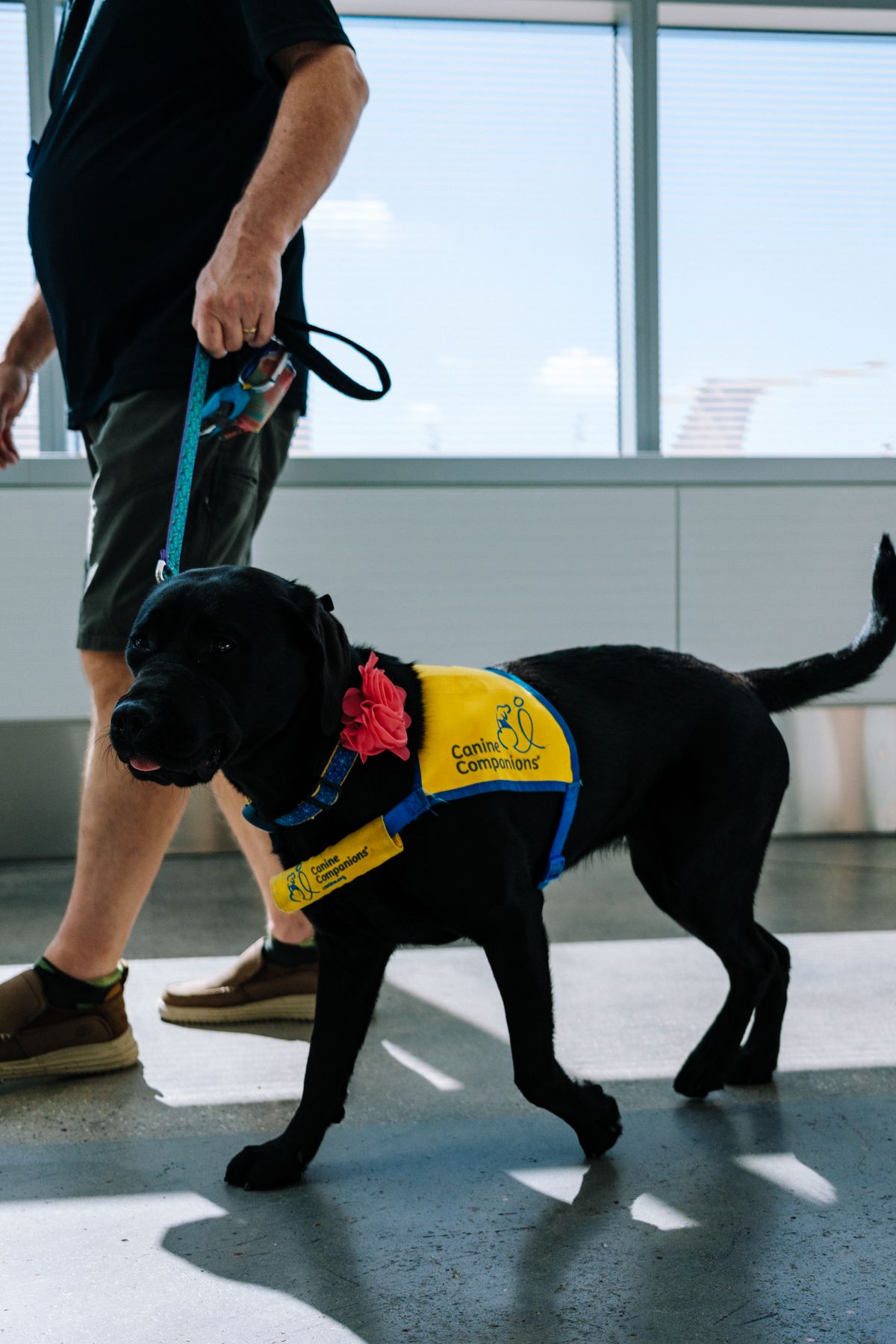
Assistance animal refusals are a recurring pattern in disability discrimination claims. A clear policy and trained staff prevent a manageable moment becoming a claim. Photo: Pexels (free to use).
These patterns matter because they show where organisations consistently get caught. The duty isn't abstract. It plays out in specific, repeated ways. The same patterns show up on our reasonable adjustments examples page, set out from the other side: what a good adjustment looks like before it becomes a claim.
The Wider Costs Beyond Compensation
Compensation is the headline number, but it isn't where most of the cost sits.
Legal costs. Even a straightforward case that settles early runs into thousands in legal fees. A contested case that goes to trial runs into tens of thousands. And the losing service provider usually pays a significant part of the claimant's costs.
Reputational damage. Disability discrimination cases are public. Local and trade press pick them up. Social media amplifies them. A case about a venue turning away an assistance animal or charging a disabled fan's companion full price can travel further than any marketing campaign you run that year.
Insurance impact. If you carry public liability or management liability insurance, a discrimination claim affects your claims history and your premium. Some policies exclude discrimination claims entirely or carry high excesses. Check your cover before you need it.
Staff time and morale. A case absorbs senior management time, pulls staff into witness statements and disclosures, and demoralises front-line teams who often knew the policy was wrong but couldn't get anyone to listen.
The change you end up making anyway. Most organisations that lose a case go on to make the adjustment they should have made in the first place. They make it under pressure, at greater cost, after a public finding against them. The same change, made proactively, costs a fraction of that.
The organisations that avoid these claims aren't the ones with the biggest budgets. They're the ones who did the work, documented it, and can show a Court they took the duty seriously.
What Organisations Should Do to Avoid It
The defensible position isn't complicated, but it does take work.
Run a structured reasonable adjustments review. Walk the customer journey from booking to exit. Identify every barrier. For each barrier, work through the factors the Courts use. Document the decisions, including the ones you decided not to act on and why. Our Disability Impact & Risk Assessment is built for exactly this.
Train your front line. Stewards, box office, reception, security contractors. They need to know what a reasonable adjustment is, what your organisation provides, and how to handle an access request without creating a new barrier. Training programmes that are sector-specific, not generic EDI modules, are what actually changes behaviour on the floor.
Check your policies. Ticketing, companion, pricing, T&Cs, refund, privacy, evacuation. Policies are the most common source of failures and the easiest thing to fix.
Have a complaints process that actually works. A complaint that's acknowledged within 48 hours, investigated properly, and resolved with a genuine apology and a fix is far less likely to become a claim. A complaint that's ignored or fobbed off is the start of a litigation file.
Review your insurance. Know what your policy covers, what it excludes, and what your excess is. Some specialist policies include discrimination cover. If yours doesn't, ask why.
Get specialist help before you need it. An access review by someone who knows your sector and the caselaw is cheaper than a single defended claim. It also produces the paper trail that shows your organisation took the duty seriously.
The Bottom Line
Failure to make reasonable adjustments compensation isn't a theoretical risk. The Courts are awarding real money, in real cases, against organisations that didn't do the thinking in advance. The duty is anticipatory, the awards are rising, and the reputational cost runs alongside the financial one.
The organisations that avoid these claims aren't the ones with the biggest budgets. They're the ones who did the work, documented it, and can show a Court they took the duty seriously. That's the position worth building.
Not confident you'd withstand a claim?
Book a discovery call. We'll review your current position, identify the gaps, and give you a clear, defensible plan before a complaint becomes a case.
Get in TouchAbout the author
Chris Fry leads Strategic Access Advisory Limited, a specialist accessibility consultancy based in Sheffield. Chris has decades of experience in Courts, including the Court of Appeal and Supreme Court, translating the Equality Act 2010 into operational improvements for venues, sports organisations, entertainment companies, and live events businesses.
For enquiries about reasonable adjustments reviews, disability discrimination risk assessments, or subscription support, contact Strategic Access Advisory Limited directly via strategicaccessconsulting.com.
Sources and references
- Equality Act 2010, sections 20, 21 and 29 (reasonable adjustments duty for service providers)
- Vento v Chief Constable of West Yorkshire Police [2003] IRLR 102, CA, and the Ninth Addendum to the Presidential Guidance on Vento bands (March 2026), applying to claims presented on or after 6 April 2026
- EHRC Statutory Code of Practice for Services, Public Functions and Associations (in force 5 August 2026)
- Equality and Human Rights Commission guidance on disability discrimination and compensation
- Sector caselaw on accessible ticketing, assistance animal refusals, and evacuation planning (PEEPs)
The Vento band figures reflect the Ninth Addendum to the Presidential Guidance issued in March 2026, applying to claims presented on or after 6 April 2026. The bands are reviewed annually and the figures move. This article provides general legal and operational information and isn't legal advice on any particular circumstances. If you need advice on your organisation's specific situation, seek independent legal counsel.